






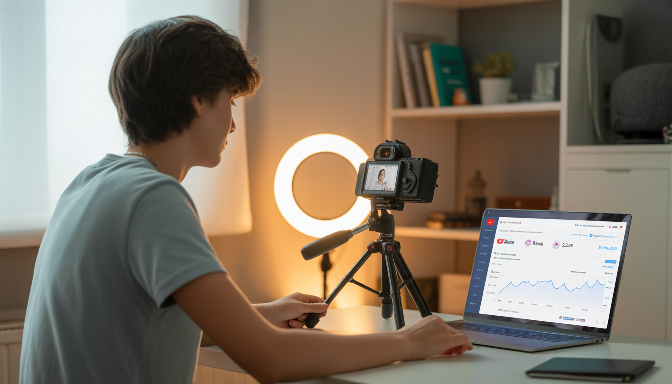
Starting a YouTube channel sounds simple enough. You pick a topic, record a video, upload it — done. But if you’ve tried that and watched your view count stall at 12 (three of which were you), you already know that “just posting” doesn’t really cut it.




Growing a channel organically in the US market is a different game than most people expect. It’s slower, yes. But when it works, the growth compounds in a way that paid promotion simply can’t replicate. Real subscribers. Real watch time. Real community.

This guide breaks down exactly how to do it, from the ground up.
Why Organic Growth Still Works — and Why It’s Worth Doing
A lot of people look at YouTube and think the algorithm is everything. And sure, the algorithm matters. But organic growth is really about something more fundamental: building an audience that actually wants to watch you.
When someone finds your video through a search or a recommendation, and they watch it all the way through, subscribe, and come back for more — that’s a signal YouTube reads loud and clear. It pushes your content to more people. Over time, this creates a feedback loop.
Contrast that with buying views or chasing viral moments. Those spikes don’t stick. YouTube’s own data has shown that channels with consistent engagement outperform channels with occasional spikes but weak audience retention.
The US audience is also particularly valuable for creators because of higher ad revenue rates (CPM), access to brand deals, and the sheer size of the market. But that same audience is also more discerning. You’ll need to earn their attention.
Step 1: Get Ruthlessly Specific About Your Niche
The single biggest mistake new creators make is being too broad. “Fitness” isn’t a niche. “Budget home workouts for people over 40” is a niche.
Why does this matter? Because YouTube’s recommendation engine needs to know who to show your videos to. If your channel covers cooking, travel, and personal finance, the algorithm genuinely doesn’t know what to do with you.
Pick one topic. Then narrow it down further. Then ask yourself: is there already content on this, and is there a gap I can fill?
How to Test Your Niche Before You Commit
Before you record a single video, spend a week watching YouTube as your target viewer. Search the keywords you’d expect them to use. Note what comes up. Look at which channels are covering this well, which ones are doing it poorly, and where the comments reveal frustration or unanswered questions.
Those unanswered questions? That’s your content calendar for the next three months.
A creator named Ali Abdaal didn’t start with “productivity.” He started with “Cambridge medical student study tips” — absurdly specific. That specificity got him early traction, and he expanded from there.
Step 2: Understand What the US Audience Actually Responds To
The American YouTube viewer isn’t monolithic. A 19-year-old in Texas and a 45-year-old in Oregon are both “US viewers” but they want completely different things. That said, there are patterns that hold up across demographics.
Americans tend to respond to:
- Directness. Get to the point. Don’t meander for three minutes before explaining what the video is about.
- Personality. Generic, voiceover-only content has a ceiling. If viewers connect with you, they come back.
- Practical value. “How to” content, tutorials, and problem-solving videos have consistently strong search volume in the US.
- Authenticity over polish. Especially post-pandemic, audiences have shown they’re comfortable with creators who feel real, even if the lighting isn’t perfect.
This doesn’t mean you skip quality entirely. Audio quality, in particular, matters more than video quality. A slightly grainy video with clear audio will outperform a beautiful video with echoey sound every single time.
Step 3: Set Up Your Channel the Right Way
Before you publish anything, spend a few hours making sure the basics are in order. This isn’t glamorous work, but it pays off.
Channel Name and Handle
Choose something memorable and relevant to your content. Avoid names that are too clever or too vague. If your name is John Smith and you make financial content, something like “John Smith Money” is infinitely more searchable than “JS Ventures” or whatever abstract thing sounds cool right now.
Your handle (the @username) should match or closely echo your channel name. Keep it consistent across platforms so people can find you everywhere.
Channel Art and Description
Your banner and profile picture should clearly communicate what your channel is about at a glance. A good test: if someone lands on your channel page for the first time with no context, can they tell within five seconds what you do?
Your channel description is also indexed by Google. Write it naturally, include the keywords you want to rank for, and be specific about who the channel is for.
Sections and Playlists
Organize your channel into playlists from day one. This keeps visitors engaged longer and signals to YouTube that your content is structured and coherent. Group videos by topic or format (tutorials, reviews, vlogs — whatever fits your niche).
Step 4: Master the First 48 Hours of a Video
YouTube uses the first 48 hours of a video’s life to gauge whether it deserves to be promoted. During that window, it’s watching engagement signals carefully.
This is why publishing and praying doesn’t work.
Write Titles That People Actually Search
This is where most new creators drop the ball. A title like “My Morning Routine” is weak. “Morning Routine That Helped Me Wake Up at 5AM Without an Alarm” is better. Why? Because it answers a question someone might actually type into the search bar.
Use tools like YouTube’s auto-suggest feature (just start typing a keyword and see what comes up) to understand what real people are searching for. The suggestions are based on actual search data.
Thumbnails Are 80% of Your Click-Through Rate
Most viewers see your thumbnail before they read your title. If the thumbnail doesn’t make them curious or promise them something useful, they scroll past — regardless of how good the video actually is.
Simple, high-contrast thumbnails with a clear focal point tend to perform best. Avoid clutter. One expressive face or a bold visual beats a collage of images almost every time.
Study the top performers in your niche. Not to copy them, but to understand the visual language your audience already responds to.
Write Chapters and a Strong Description
Chapters (timestamps in your description) improve watch time because viewers can jump to what they need, and they’re more likely to stay if they feel in control. Descriptions also help YouTube understand what your video is about — treat them like a short blog post about your video’s topic.
Step 5: Consistency Beats Frequency
Here’s a truth nobody tells you early enough: one video a week, published reliably for a year, will outperform three videos a week for two months followed by a two-month gap.
The US audience, particularly on YouTube, builds habits around creators. They subscribe because they expect to see you again. When you disappear, they forget. When you come back, the algorithm has often moved on.
That said, don’t confuse consistency with exhaustion. Burning out at 50 videos is worse than sustainable output at 26.
Find a pace you can maintain with your current life. If that’s once a week, great. If it’s once every two weeks, that’s fine too — just be honest with yourself and stick to it.
Batch Recording Helps
Many creators solve the consistency problem by batching. Record three videos in a single day. Edit them across the week. You’ll always have something in reserve for when life gets in the way — because it will.
Step 6: Optimize for Watch Time, Not Views
YouTube’s algorithm prioritizes watch time over raw view counts. A video with 1,000 views and 70% average view duration will often outrank a video with 10,000 views and 20% duration.
What this means practically: the beginning of your video is where you lose people, and it’s where you should spend the most production effort.
The First 30 Seconds Matter Most
Don’t start with a long intro. Don’t start with your name, your logo animation, or “welcome back to the channel.” Start with something that rewards the viewer for clicking — a hook, a surprising fact, a question they want answered.
The promise you made in your thumbnail and title needs to be validated in the first 30 seconds. If it isn’t, viewers leave, and that hurts your retention metrics badly.
Pacing and Editing
American audiences, especially younger demographics, have been trained by TikTok and Instagram Reels to expect a certain pace. This doesn’t mean you need to edit like a caffeine-fueled highlight reel. But dead air, long silences, and rambling tangents are retention killers.
Cut pauses. Trim repetition. Keep every scene earning its place.
Step 7: Build Community Early
Organic growth doesn’t just come from the algorithm. It comes from people talking about you.
Respond to Every Comment in the First Month
When your channel is small, responding to comments is one of the highest-leverage things you can do. It signals to YouTube that your video drives engagement. It signals to viewers that you’re a real person who gives a damn. And early commenters often become your most loyal subscribers if you treat them well.
A creator who responds to “great video” with a genuine, personal reply is far more memorable than one who doesn’t respond at all.
Ask Specific Questions at the End of Videos
“Let me know what you think in the comments” gets ignored. “What’s the one thing stopping you from [topic]?” gets answered. Specific questions invite specific responses.
Step 8: Leverage Search-Based Content First, Then Build Toward Discovery
There are two main ways viewers find content on YouTube: search and discovery (the homepage/suggested videos). Most new channels can’t crack discovery early on — the algorithm doesn’t know enough about your audience yet.
Focus your first 20–30 videos on search-based content: tutorials, how-to guides, comparisons, and “best of” roundups in your niche. These have longer shelf lives and find viewers over months, not just days.
Once your channel has data — subscribers, watch time, defined audience demographics — the algorithm starts placing your content in the suggested feed alongside established channels. That’s when growth tends to accelerate.
Step 9: Treat Your Analytics Like Feedback, Not a Report Card
A lot of creators check their analytics, see a low view count, and feel defeated. That’s the wrong frame.
Analytics are information. They’re telling you what’s working and what isn’t. When you publish five videos and one outperforms the others by a wide margin, that video is a signal. Make more content like it.
Metrics That Actually Matter for Early Channels
- Click-through rate (CTR): Are people clicking your thumbnails when they see them? Under 3% usually means thumbnail or title issues.
- Average view duration: Are people watching? Under 40% means your content is losing them early.
- Subscriber conversion rate: Of the people watching, how many are subscribing? If it’s very low, you may not be giving them a clear reason to come back.
Don’t obsess over subscriber count in the early months. Focus on improving these underlying metrics first.
Step 10: Play the Long Game — Most Channels Take 12–18 Months to See Real Traction
This part is uncomfortable but important: most YouTube channels that succeed today were started by people who kept going when nothing seemed to be working.
The creator economy has a survivorship bias problem. You see the channels that made it. You don’t see the thousands that quit at video 15 or video 40 because the numbers weren’t there yet.
The US market rewards persistence partly because so many people give up. If you’re still consistently publishing high-quality, niche-specific content at month 12, you’re already ahead of most people who ever started.
It also helps to remember why you started. If your only motivation is views and money, the slow early months will break you. If you genuinely care about the topic and the audience, you’ll find the stamina to keep going.
Common Mistakes That Kill Organic Growth
Changing niche too early. Give a niche at least 30 videos before concluding it isn’t working. Most channels pivot too soon.
Ignoring audience feedback. Comments, DMs, and even negative feedback contain real information about what your audience wants. Use it.
Copying successful creators instead of learning from them. Studying top creators is useful. Imitating their exact style, editing, and topics is not. The market already has them.
Optimizing for subscribers before optimizing for quality. Sub-for-sub schemes and giveaway tricks inflate numbers without building real audiences. YouTube’s algorithm is smart enough to notice weak engagement.
Giving up before the compounding begins. Growth on YouTube is almost never linear. Many channels have a long flat period followed by sudden acceleration. Most people quit during the flat part.
A Note on Monetization
Organic growth and monetization aren’t at odds, but they are sequential. Focus on building a real audience first. Monetization — whether through YouTube’s Partner Program, brand deals, or your own products — follows naturally from genuine influence.
The YouTube Partner Program in the US requires 1,000 subscribers and 4,000 hours of watch time in the past 12 months. For channels with strong niche focus, this is usually achievable within the first year of consistent publishing.
Once you’re monetized, US-based channels tend to earn significantly higher CPMs than global averages, particularly in finance, technology, health, and business niches — sometimes $10–$30 per thousand views or more.
But that all comes later. In the beginning, focus on serving a specific audience well. The rest follows.